China aims to deploy 5G-Advanced (5G-A) and 10-gigabit fiber networks in priority areas and largely complete a low-Earth-orbit satellite internet system by 2030. A national implementation plan made public on November 26, 2026, also calls for construction of 6G networks to begin when the time is right, without setting a launch date.
The Ministry of Industry and Information Technology, the Cyberspace Administration of China and the National Development and Reform Commission jointly issued the plan. It envisions networks that connect people, machines, objects and intelligent agents, with coverage extending beyond land to the air, space and sea.
Research priorities include 6G base stations and core network equipment, ultra-high-speed optical communications and satellite equipment. Wang Zhiqin, vice president of the China Academy of Information and Communications Technology, said the work could strengthen the domestic supply chain for network equipment, smart devices, high-speed components, core chips and testing instruments.
How industry is using 5G
The industry ministry has launched a new round of city pilots that combine 5G with the industrial internet. China already has more than 27,000 such projects, according to Tang Libo, deputy director of the academy’s Institute of Technology and Standards. CCTV reported that 5G applications now span all 97 major categories of China’s economy.
At a toothpaste factory in Kunming, Yunnan province, more than 7,500 sensors feed production data over an internal 5G network to a cloud-based model for real-time processing. The factory can track materials from their origin through shipment of the finished product. Dang Yabin, who heads the company, said testing efficiency had increased more than 300-fold, cutting a process that once took more than 10 hours to a few minutes. He said 5G-connected mobile processing units also allow medicinal herbs to be processed in the fields where they are grown.
In Hulunbuir, Inner Mongolia, an open-pit mine completed what CCTV described as China’s first test of gigabit 5G-A upload speeds in that setting. Nearly 100 driverless electric mining trucks operate around the clock, loading, unloading, avoiding obstacles and swapping batteries automatically. Compared with conventional 5G, the system improved overall transport efficiency by 20% and reduced the cost of hauling a tonne of coal by 10%, CCTV reported.
What the 6G pilots will test
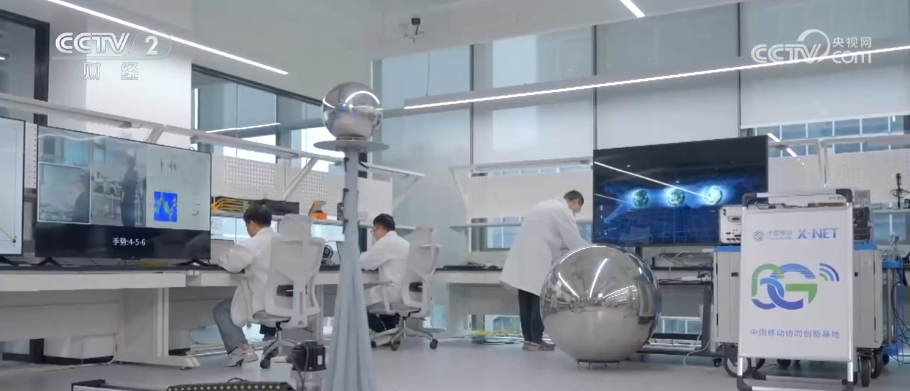
Eight provinces and municipalities, including Beijing, Hebei and Jiangsu, will take part in 6G pilots coordinated with the ministry. They will explore how new devices, components, operating systems and satellite internet could support applications such as immersive communications, manufacturing, embodied intelligence and marine monitoring and services.
In Nanjing, Jiangsu province, researchers are testing whether several base stations working together can track moving objects more accurately than one station alone. Future 6G stations could combine communications with radar-like sensing for uses such as low-altitude aviation and autonomous driving. CCTV reported that using multiple stations can improve sensing accuracy by about 25%. Zhong Ziguo, a researcher at Purple Mountain Laboratories, said observing the same airspace from different positions could improve detection and identification of small airborne objects.
Liu Guangyi, a chief expert at China Mobile, said early testing could show how well networks work with new devices and services, with the aim of making them ready for commercial use before 2030.