China will use 14 priority zones to guide planting, maintenance and restoration under its Three-North program, the National Forestry and Grassland Administration said. Water availability and temperatures vary widely across the program area. The aim is to judge the work by its quality and benefits as well as by the area it covers.
The administration used counties as the basic planning units, matching local conditions and priorities with 68 key projects in the program’s sixth phase. The zones fall into three regions:
- East (four zones): the Horqin Sandy Land, including the Songnen Plain; the Hunshandake Sandy Land, including the Xilingol Grassland; the sandy grasslands of Hulunbuir; and the Yanshan–Taihang mountain region.
- Center (four zones): the central and western Yinshan Mountains, including the Hetao Plain; the Kubuqi Desert and Mu Us Sandy Land; the Loess Plateau; and the Helan–Liupan mountain region.
- West (six zones): the Tengger and Badain Jaran deserts; the Hexi Corridor; the Qaidam Basin, including the Gonghe Basin; Qinghai’s alpine grasslands; the Junggar Basin; and the Taklamakan Desert.
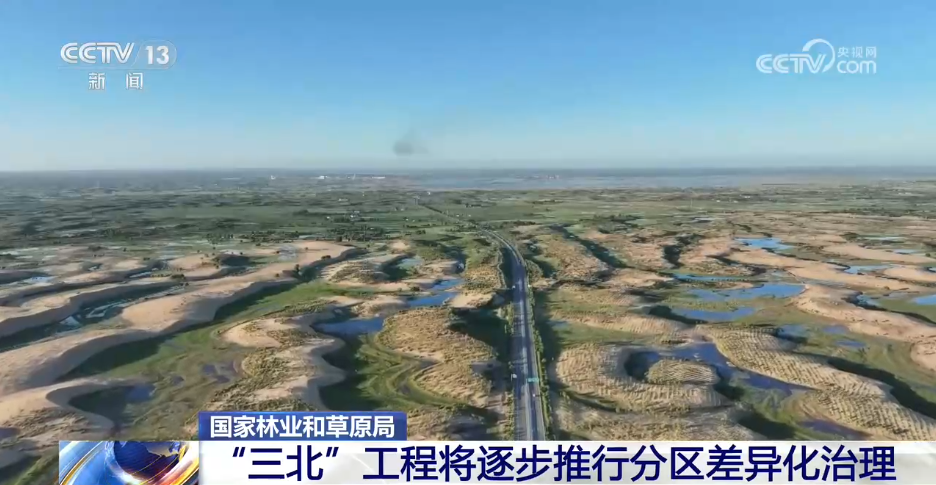
The program will also support grassland improvement as a way to control desertification. Construction of an initial 10 ecological pastures is scheduled to begin in 2027 in areas including Xinjiang and Inner Mongolia.
The central government allocated 27.7 billion yuan in 2026 for 328 key projects, with work planned across 74.48 million mu. By the time of the November 27 report, work was complete on 68.74 million mu. The report said the program had completed work on more than 80 million mu annually in the three years since the intensified campaign began. More than half of the sixth phase’s planned work was complete, with more than half of the planning period elapsed.